
Initiatives

Peru, June 19, 1986: In response to
prisoner uprisings and struggles against living conditions and the neoliberal
policies of Alan García, a brutal crackdown took place in the prisons,
resulting in the killing of nearly 300 comrades. Over time, this day acquired
symbolic international significance. Remembered as the day of the massacres of
El Frontón and Lurigancho, it is dedicated to revolutionary prisoners around
the world.
We have chosen this date both to emphasize its international
character and because the resistance of prisoners belongs, within the conflict
between the exploited and the exploiters, the oppressed and the oppressors, to
a broader revolutionary and class movement.
We remember the struggle of Irish revolutionaries in
maximum-security prisons against the H-Block system; the struggle of RAF
comrades in Stammheim prison and their deaths, which in the 1970s sparked a
strong solidarity movement, including significant protests in Italian streets;
the fierce repression in Italy against mobilizations supporting prisoners held
in the “death wings” where members of guerrilla organizations were imprisoned;
the uprisings in American prisons within the context of the African American
movement and opposition to the war; the Japanese Red Army, which fought
alongside the Palestinians for the liberation of prisoners; the struggles in
Turkish prisons against F-type cells and isolation; and the significant
experience of prisoners in Israeli prisons and, more generally, in the West,
together with the solidarity movement that developed around them. This
experience tells us that prisoners and political imprisonment cannot be
separated from resistance: to remove them from their context is to empty them
of meaning and thus serve the enemy.
We are faced with a system in crisis at its foundations. The
expansion and pervasiveness of war processes, the continuous search for
authoritarian solutions, the worsening of social conditions, and the
dismantling of achievements won through past struggles increasingly target
political movements and activists. The aim is to suffocate struggles for
resistance and liberation and to prevent social contradictions, discontent, and
conflict from finding organized political expression.
It is in this context that the war against the memory of the
struggles of the 1970s must be understood, and it is within this context that
we can understand the silencing and erasure of revolutionary prisoners.
We are speaking of the comrades referred to in the appeal “Let’s
Break a Taboo,” who for more than 40 years have endured harsh detention
conditions and endless imprisonment; of three others who for over 20 years have
been subjected to the maximum-isolation regime known as 41-bis; and of another
comrade who has been under the same regime for four years. We also speak of all
those comrades who pass through prisons under high-security regimes, of young
people, and of the entire movement that today faces not only a highly
repressive campaign through decrees and legislative proposals, but also an
ideological and media attack, involving manipulation, distortion of content,
and rhetoric centered on bourgeois legality.
The reasons behind this attack—which affects everyone from those who
rescue migrants at sea, to logistics workers’ struggles, environmental and
antifascist movements, and those who express solidarity with the Palestinian
people and their resistance—must be sought in the state's need to pacify,
control, and homogenize society. Its goal is to prevent movements from uniting
into a collective force, from building projects and perspectives for
revolutionary transformation, and instead to keep them fragmented, divided,
isolated, and forced each time to start over from scratch.
This meeting aims to contribute to finding forms and continuity for
this reflection and to connect it concretely with social struggles and their
movements, while supporting their internationalist and anti-imperialist
character.
It is also a contribution toward overturning the outlook of
distrust, fear, isolation, and defeat that suffocates struggles and prevents us
from coming to terms with a history that belongs to us in all its expressions.
These prisoners, like the prisoners of today’s movements, are the expression of
important and often courageous experiences. They must be part of our struggle;
they must be defended and supported.
No one saves themselves alone. Together, we can do everything.
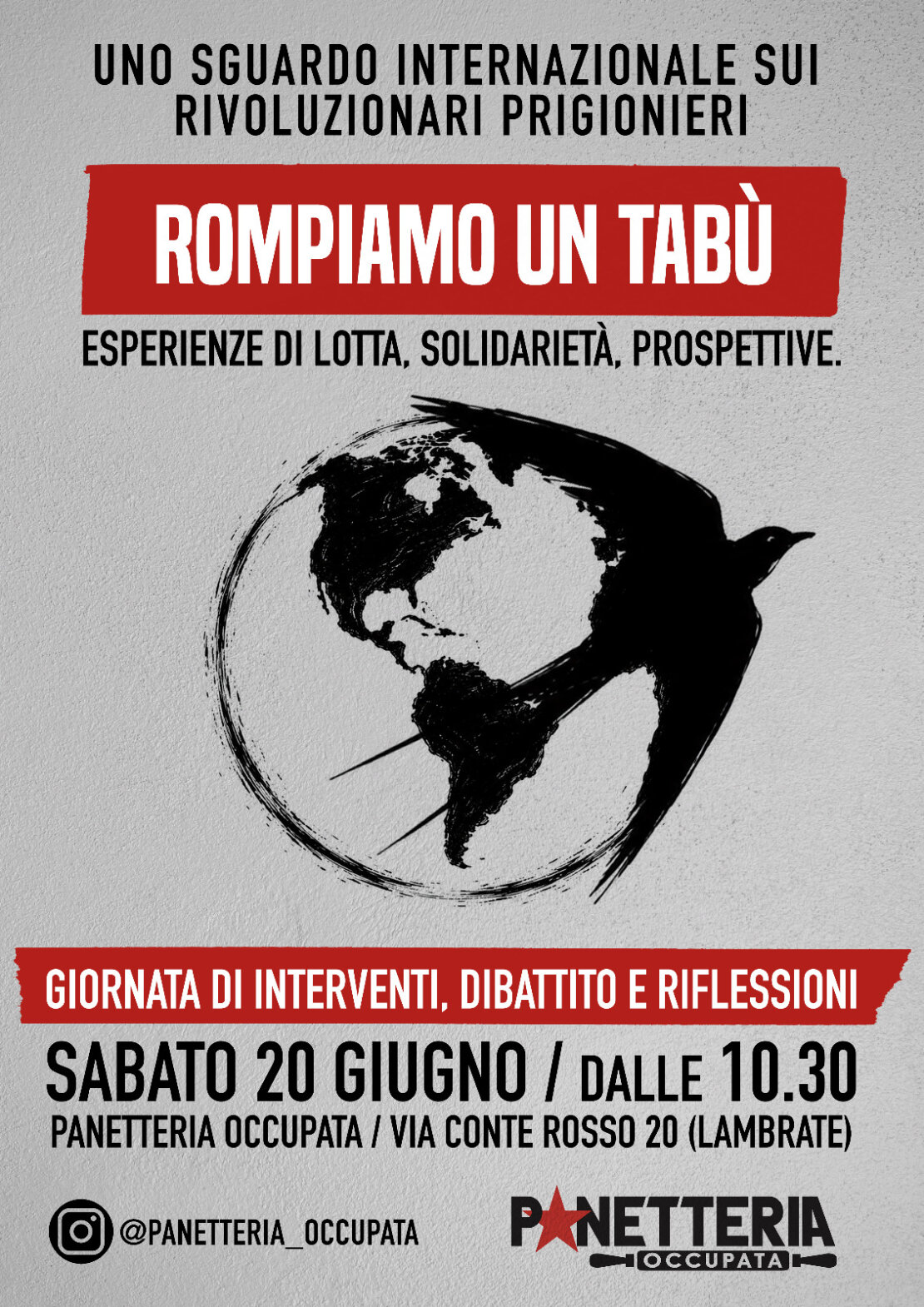
Saturday, June 20, from 10:30 a.m.
Historical and contemporary political imprisonment: a look at prison
struggles
·
Presentation of the appeal “Let’s
Break a Taboo”
·
Prisoners and resistance in
Palestine: GPI (Young Palestinians of Italy),
Samidoun (Palestinian Prisoner Solidarity Network)
·
41-bis, isolation, and the
mobilization for Alfredo Cospito: Anti-Repression
Fund of the Western Alps and lawyers
·
“The SRY-Type Isolation
Prisons and the Resistance” with a comrade from the
Anti-Imperialist Front and IS4PP (International Solidarity for Political
Prisoners)
·
Yesterday and today, the
same imprisonment, the same reasons: intervention
by a comrade from Pisa
·
Memory and Resistance: CPA Florence
Movement organizations discuss current struggles: solidarity and
perspectives. Debate and reflections
·
Si.Cobas: the right to strike in a wartime economy
·
Collettivo Antudo: prospects for struggle and repression of dissent in times of war
·
CALP Genoa: the war begins here — dockworkers’ struggle against war
·
Ultima Generazione: mobilizations against war and rearmament
·
Rete
Liberi e Libere di Lottare: state
of war and policing
Additional contributions to follow.
Top of Form
Bottom of Form